
“They went out of their way to help me with a problem fiddle leaf fig that needed some help … and brought it back to its original glory. I highly recommend them.”Juan Perez via Google
Care guide · Los Angeles & Orange County
How to keep office plants alive in Los Angeles
Everything two generations of our family have learned about interior plants since 1986 — light, water, the species that actually survive an LA office, and the local conditions that quietly kill the ones that don't.
Last updated: July 2026 · Written by the family behind Area Indoor Plants, interior plantscapers in Los Angeles and Orange County since 1986.
This is a working guide, not a brochure. Area Indoor Plants has maintained interior plants in Los Angeles offices, lobbies, restaurants, and homes since 1986, and almost everything below is the same advice we give clients standing in their own lobby. If you follow it, you will keep most office plants alive without hiring anyone. If you would rather hand the job to someone else, our plant maintenance service is at the bottom of the page.
Why office plants die (the four real causes)
Nearly every office plant that dies indoors dies from one of four causes: it was the wrong plant for the light it was given, it was watered by guesswork instead of on a schedule, nobody in the office was actually responsible for it, or the building itself worked against it — a supply vent blowing cold air, hot afternoon glass, or a long holiday closure. None of these are exotic horticultural problems, and all four are preventable before a single plant is bought.
- The wrong plant for the light. A plant that needs bright indirect light will decline in a windowless conference room no matter how carefully it is watered. Light is the constraint everything else has to work within, and it is the one that gets decided last, usually by whoever picked the spot for design reasons.
- Watering by guesswork. More office plants are killed by too much water than by too little. Saturated soil starves roots of oxygen, and by the time the leaves yellow, root rot is often past saving.
- No owner. A plant that belongs to everyone belongs to no one. The two failure modes are opposite and equally fatal: nobody waters it for three weeks, or six people water it in one week because it looked thirsty to each of them.
- The building. Air-conditioning drafts, radiant heat off west-facing glass, doors propped open on a hot windy day, and a week-long closure with the HVAC off will each undo an otherwise perfect care routine.
How much light does an office plant actually need?
Most interior plants sold for offices need what horticulturists call bright indirect light: roughly the light found within three to eight feet of a window that is not receiving a direct sunbeam. "Low light" does not mean no light — it means a plant will hold its condition slowly in a dim interior spot without growing much. A useful field test: if you cannot comfortably read printed text at midday with the overhead lights off, the spot is too dark for almost any living plant.
Measured in foot-candles, the rough working ranges are 50–100 fc for low light, 100–250 fc for medium light, and 250–1,000 fc for bright indirect light. A free light-meter app on a phone is accurate enough to tell these zones apart, and taking a reading before choosing a plant prevents most placement failures.
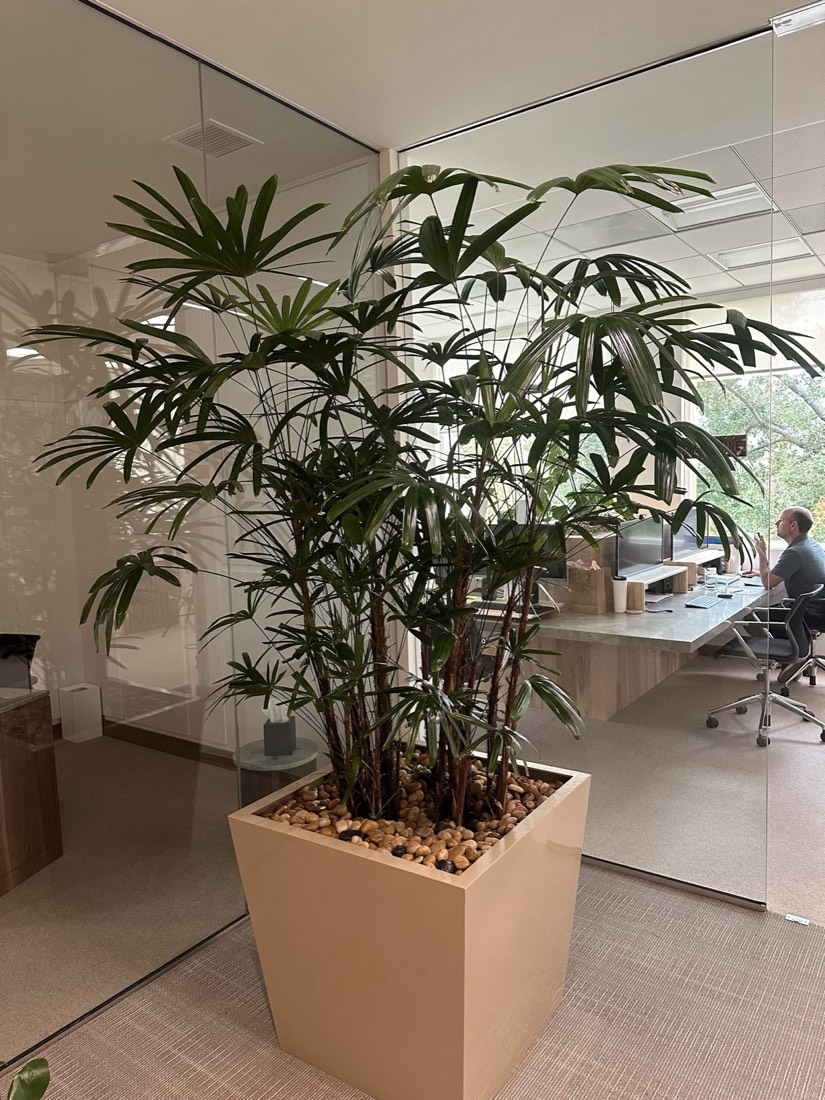
| Light zone | What it looks like in a real office | What it means for plants |
|---|---|---|
| Direct sun | South- or west-facing glass with a visible sunbeam landing on the leaves for hours | Scorches most tropical foliage. Suits cacti, succulents, and adapted ficus; pull everything else two to three feet back from the glass. |
| Bright indirect | Within about 3–8 ft of a large window, or behind a sheer shade, with no beam on the leaves | The best conditions in most offices. Monstera, kentia palm, ficus, and most floor specimens do well here. |
| Medium | About 8–15 ft from a window, or directly beside north-facing glass | Reliable for dracaena, aglaonema, philodendron, rhapis palm, and pothos. |
| Low | Interior offices, corridors, and rooms more than roughly 20 ft from any window | ZZ plant, sansevieria, aglaonema, and pothos will hold. Expect slow growth, and expect to rotate plants eventually. |
| No natural light | Windowless rooms lit only by overhead fixtures on a timer | No living plant thrives long term. Use a rotation program, horticultural lighting, or non-living greenery such as a preserved moss wall or a custom faux tree. |
North, south, east, west — what exposure means in an LA office
In Los Angeles, as everywhere in the northern hemisphere, north-facing windows give soft, even light all day and never a hot beam, which makes them the easiest exposure for ferns, aglaonema, and other foliage that burns easily. South-facing glass delivers the most light hours of any exposure and is excellent a few feet back from the window. West-facing glass is the harshest in an LA summer: afternoon sun plus radiant heat off the pane will cook leaves pressed against it. East-facing windows give gentle morning sun and suit almost anything.
Why glass towers are darker than they look
Floor-to-ceiling glass in Downtown Los Angeles and Century City offices reads as extremely bright to the human eye, but much of that glazing is tinted or low-emissivity, which cuts the light plants can actually use. Human vision adapts to a huge range of brightness; a plant does not. Meanwhile, a specimen set directly against a west-facing pane gets glare, heat, and cold-night radiation all at once. Setting floor plants two to three feet back from the glass solves both problems at once.
One more common misunderstanding: standard overhead office LEDs contribute very little usable light for photosynthesis. Purpose-built horticultural fixtures running long hours are a real solution for a dark space; ordinary ceiling lighting is not.
How often should office plants be watered?
Most office plants in Los Angeles need water every 7 to 14 days, but frequency is the wrong way to think about the problem. The right method is a fixed inspection schedule with a variable pour: every plant gets checked on the same day each week or every other week, and only the plants that are actually dry get watered. That is precisely what a professional service route does, and it is why scheduled care beats good intentions.
Why overwatering kills more office plants than underwatering
Roots need air as much as they need water. Soil that stays saturated suffocates them and invites root rot, which is usually irreversible by the time the symptoms reach the leaves. The cruelty of it is that the warning signs run backwards from what people expect: an underwatered plant wilts visibly and perks up within hours of a drink, while an overwatered plant looks fine right until it collapses.
Offices make this worse in two specific ways. First, decorative containers often have no drainage, so excess water pools invisibly in the bottom and the root ball sits in it for weeks. Always water thoroughly, let it drain, and then empty the cache pot or saucer — never leave a plant standing in water. Second, communal plants get watered by everyone: a splash of leftover meeting-room water here, coffee dregs there, five times a week. A small card asking colleagues not to water, plus one named owner, fixes more office plant problems than any product.
How to tell if a plant is actually dry
- Push a finger about two inches into the soil. Cool and damp means wait; dry and crumbly means water.
- Lift or tilt the pot. A dry root ball is dramatically lighter, and after a few weeks the difference is obvious by hand.
- Water thoroughly when you do water — until it runs from the drainage holes — rather than giving small daily sips, which wet only the top inch and leave the roots dry.
- Expect to water less from November through February. Lower light means slower growth and slower water use, so keep the same inspection schedule and simply skip more plants.
The best plants for low-light Los Angeles offices
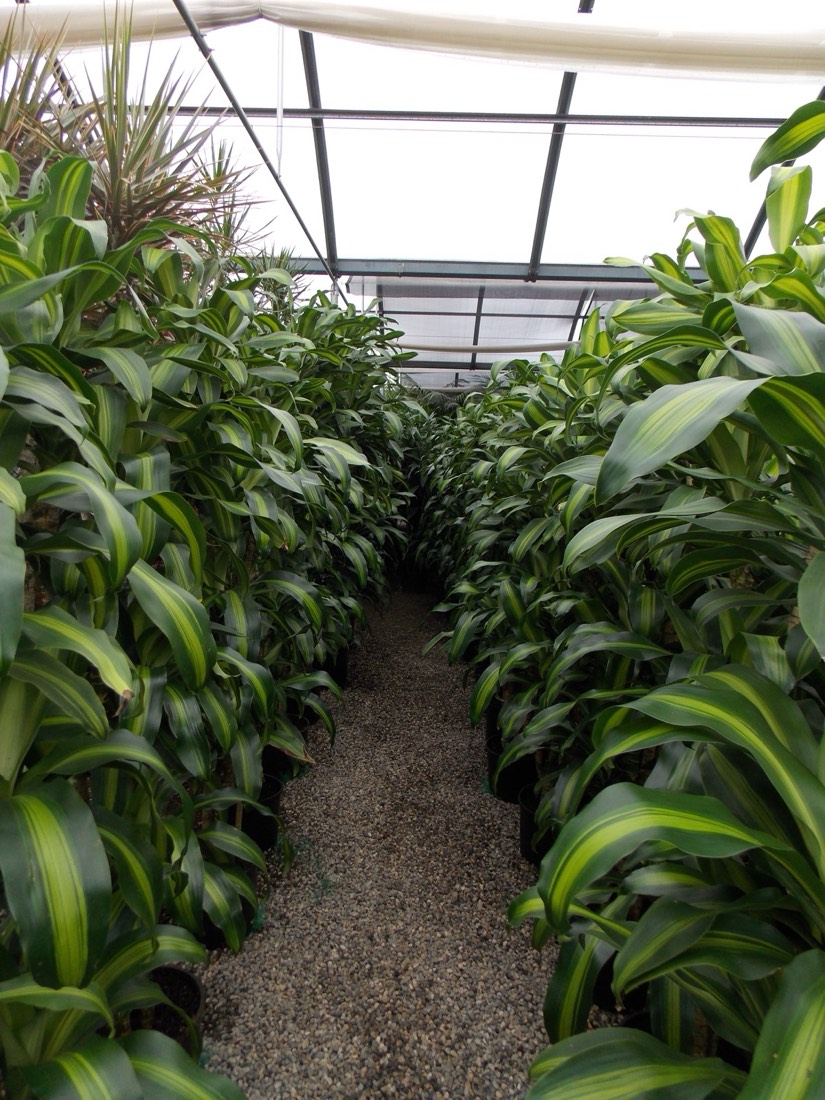
The most reliable plants for low-light Los Angeles offices are ZZ plant, snake plant (sansevieria), pothos, philodendron, dracaena, and aglaonema — all of which tolerate dim interior light, dry air, and irregular watering. For a brighter spot, rhapis and kentia palms and monstera are the dependable choices. Most of the plants in the table below are ones we hand-pick from partner nurseries across Los Angeles and Orange County for client installations.
| Plant | Light needed | Water | Honest notes |
|---|---|---|---|
| ZZ plant Zamioculcas zamiifolia |
Low to medium | Every 2–3 weeks | The most forgiving plant on this list. Stores water in its rhizomes, so it survives forgotten weeks and dies from overwatering, not neglect. |
| Snake plant Sansevieria / Dracaena trifasciata |
Low to bright | Every 2–4 weeks | Nearly indestructible and architectural. Tolerates dry LA office air better than almost anything. Rot is the only real risk. |
| Pothos Epipremnum aureum |
Low to bright indirect | Weekly to every 10 days | A dependable trailing plant for shelves and cabinet tops. Wilts obviously when thirsty, which makes it easy to read. Cuttings root in water. |
| Philodendron heartleaf and larger cultivars |
Low to medium | Weekly to every 10 days | Fast, lush, and adaptable. Larger cultivars make good floor plants; heartleaf is a workhorse for desks and dividers. |
| Dracaena 'Janet Craig', 'Lisa', marginata |
Low to medium | Every 1–2 weeks | The backbone of commercial interiors — upright, long-lived, tolerant. Sensitive to fluoride and salts in tap water, which shows as brown tips. |
| Aglaonema Chinese evergreen |
Low to medium | Every 1–2 weeks | Unusual color for a true low-light plant, with silver, cream, and red variegated cultivars. Dislikes cold drafts. |
| Rhapis palm lady palm |
Medium | Weekly | Among the most shade-tolerant palms grown indoors, and slow-growing, so it holds its shape for years. Non-toxic to pets. |
| Kentia palm Howea forsteriana |
Medium to bright indirect | Weekly | The classic lobby palm — elegant, durable, forgiving of indoor conditions. Also non-toxic to pets. Costs more than most floor plants. |
| Monstera Monstera deliciosa |
Bright indirect | Weekly | A fast, dramatic statement plant. Needs real light and room to spread; will not hold in a dark corner. |
| Fiddle-leaf fig Ficus lyrata |
Bright indirect only | Weekly, consistently | Difficult. Beautiful and heavily photographed, but it drops leaves after any change in light, temperature, or routine. Only worth it near a bright window with consistent care. |
Pet-friendly note: pothos, philodendron, dracaena, ZZ plant, and monstera are all toxic if chewed. If dogs visit your office, kentia and rhapis palms are the safer floor specimens.
Los Angeles-specific challenges
Los Angeles is an easier climate for interior plants than most of the country — no freezing loading docks, no radiators baking a lobby all winter — but it brings its own set of problems: very low indoor humidity, Santa Ana wind events, aggressive air conditioning, hard tap water, and long holiday closures in buildings with the HVAC switched off.
| LA condition | What you see on the plant | What helps |
|---|---|---|
| Dry indoor air | Crispy brown leaf tips and edges, especially on palms, dracaenas, and calatheas | LA offices often sit at 20–40% relative humidity, below the 40–60% most tropical foliage prefers. Group plants together, use pebble trays, and favor tolerant species. Misting does almost nothing — the water evaporates in minutes. |
| Santa Ana winds | Sudden tip burn and wilting even when the soil is still moist | Santa Ana events, most common from roughly September through April, drop humidity into the single digits and push hot dry air through propped-open lobby doors. Move plants away from entries during an event and check soil sooner than usual afterward. |
| Air-conditioning drafts | Leaf drop and damage on one side of the plant only | Never place a plant directly beneath a supply diffuser. Three feet of clearance from any vent is usually enough. |
| Hard tap water and salts | White crust on the soil surface and pot rims; brown tips on sensitive species | Flush pots thoroughly with clean water every few months to leach accumulated salts. Avoid water from a softener, which adds sodium, and use filtered water for dracaenas, palms, and spider plants. |
| Long weekends and holiday closures | Dry, wilted plants in January; sunburn on specimens left against glass | A closed building with the HVAC off gets hot fast. Schedule a service visit immediately before a long closure and pull plants back from west-facing glass. |
| Seasonal light shifts | A plant that thrived all summer declining in December for no obvious reason | The sun angle drops sharply from October to February, and a desk that received bright light in June may be a medium-light spot in winter. Re-evaluate placements twice a year and move marginal plants closer to glass in winter. |
Signs your plants need professional help
Call a professional when a plant is declining for a reason you cannot identify, when a plant has failed twice in the same spot, or when you see any sign of insects — because pests on one plant become pests on every plant within weeks in a warm office. These are the specific signals worth acting on:
- Sticky residue on leaves, desks, or the floor beneath a plant — honeydew from scale or mealybugs.
- Fine webbing at leaf joints and dull, stippled foliage — spider mites, which thrive in dry Los Angeles air.
- Small white cottony clusters tucked where leaves meet stems — mealybugs.
- Clouds of fungus gnats — almost always a symptom of soil staying too wet.
- Yellowing that starts low and climbs, with mushy stems and sour-smelling soil — root rot, and a plant that likely cannot be saved.
- The same spot killing a second plant — that is a placement problem, not a plant problem, and swapping in a third identical plant will waste your money.
- Trees leaning or root balls loose in their containers, or plants visibly outgrowing their pots.
- Everything looking tired but alive — dusty leaves, no new growth, salt crust on the soil. This is the most fixable condition of all, and the one people wait longest to address.
What professional maintenance actually does differently
Professional interior plant maintenance is not just watering. Every Area Indoor Plants maintenance visit includes watering, feeding and fertilizing, pruning and trimming, cleaning and dusting the foliage, and a pest and disease inspection on every plant. The real difference is not any single task — it is that a trained person examines every plant on a fixed schedule and catches decline in the week it starts rather than the month it becomes obvious.
| Task | Typical in-house approach | On a professional service route |
|---|---|---|
| Watering | Whoever remembers, at whatever interval | Every plant inspected on schedule; only the dry ones watered, and excess drained from cache pots |
| Feeding | Rarely done at all | Fertilized at appropriate rates, heavier in the growing season and lighter in winter |
| Cleaning | Skipped | Foliage dusted and wiped — dust blocks light, so cleaning is horticulture, not cosmetics |
| Pruning | Occasional trimming of dead leaves | Shaped and thinned so plants keep their intended form and the design still reads years later |
| Pests | Noticed once an infestation is visible across the office | Inspected every visit and treated at first sign, before it spreads |
| Replacement | Buy another plant and hope | Free replacement of declining plants on our Guarantee Maintenance and Maintenance Lease with Guarantee plans |
It also starts earlier than the first visit. Area Indoor Plants offers a free on-site walk-through anywhere in Los Angeles County and Orange County, with a written proposal in your hands within one business day — and the point of that walk-through is to read your light before anything is ordered, so the plant in each spot is one that can actually live there. Plants are hand-picked from several partner nurseries across Los Angeles and Orange County and installed by our own crew.
Our four service plans are Every-Other-Week maintenance, starting at $225 per month, Weekly maintenance, Guarantee Maintenance, and Maintenance Lease with Guarantee. Most programs run $225–$450 per month. Free replacement of declining plants is included on the two Guarantee plans only — it is not part of plain Every-Other-Week or Weekly maintenance, and we would rather say so plainly than surprise you later. Larger installations, moss walls, and custom work are quoted individually. Full details are on our pricing page and in our breakdown of the cost of office plants in Los Angeles.
“Professional. Reliable. Excellent. Thank you Augustin and his son, Luca! They are the experts in what they do. They came in time to rescue our indoor plants.”Hans Koes via Google
“Augustin, the owner, and all the crew at Area Indoor Planting are very responsive… They have a good creative department. Four years ago, they helped us design a Christmas theme for our main lobby.”Robert Lara via Google
★★★★★ 5.0 on Google · 19 reviews
If you would like a second opinion on plants you already own, we are happy to give one on a free walk-through — including in Studio City, Hollywood, Beverly Hills, Downtown LA, Sherman Oaks, and Pasadena. See the full service areas, our office plant service, plant leasing, and residential work.
Care questions
Frequently asked
How often should office plants be watered?
Most office plants in Los Angeles need water every 7 to 14 days, but the interval matters less than the method. Check every plant on a fixed schedule and water only the ones that are actually dry: push a finger about two inches into the soil, and if it is cool and damp, skip it. Watering on a rigid calendar regardless of soil moisture is the single most common way office plants are killed.
Why are the tips of my office plant's leaves turning brown?
Brown, crispy leaf tips on office plants are usually caused by dry air, mineral and salt buildup from tap water, or inconsistent watering. Los Angeles office air often sits at 20 to 40 percent relative humidity, below the 40 to 60 percent most tropical foliage prefers, and dracaenas, palms, and spider plants are especially sensitive to fluoride and softened water. Flushing the pot thoroughly with clean water every few months and moving the plant away from air-conditioning vents usually helps.
What is the best plant for an office with no windows?
No living plant thrives long term in a room with no natural light at all. ZZ plant, snake plant (sansevieria), pothos, and aglaonema are the most tolerant of very low light and can hold for a while, but they will not grow. The honest options for a windowless room are a rotation program that swaps plants in and out, supplemental horticultural lighting, or non-living greenery such as a preserved moss wall or a custom faux tree.
Do office plants need to be fertilized?
Yes. A plant in a container has access only to the nutrients in that container, and potting soil is exhausted within months. Interior plants are generally fed a diluted balanced fertilizer during the active growing season and fed less or not at all in the low light of winter. Feeding is part of every Area Indoor Plants maintenance visit, along with watering, pruning, cleaning, and pest and disease inspection.
Should I mist my office plants?
Misting is largely ineffective for raising humidity, because the water evaporates within minutes and the plant is back in dry air. Grouping plants together, using a pebble tray, or selecting species that tolerate dry air — ZZ plant, sansevieria, dracaena — does far more. Wiping dust off foliage is genuinely useful, but that is cleaning rather than misting.
Can I keep a fiddle-leaf fig in a Los Angeles office?
A fiddle-leaf fig (Ficus lyrata) can work in a Los Angeles office, but only in a genuinely bright spot near a window, with steady watering and no cold drafts. It is the most demanding plant on most office plant lists: it drops leaves after any sudden change in light, temperature, or watering routine, and it does not tolerate the dim interior spots where a ZZ plant or a kentia palm would be fine.
Last updated: July 2026 · Area Indoor Plants (Area Indoor Planting Co.), Los Angeles, California · Family-owned since 1986 · (818) 957-8719
Want a second opinion on your plants?
Free on-site walk-through anywhere in Los Angeles and Orange County, written proposal within one business day, and Guarantee plans that replace declining plants free.