
Family-owned & operated in Los Angeles since 1986 Call us: (818) 957-8719
Reference · A to Z

Interior plantscaping glossary

Thirty-six terms you will hear on a plant proposal, a service visit, or a design walk-through — defined in plain English by Area Indoor Plants, a family-owned interior plantscaping company in Los Angeles since 1986.

This glossary defines the vocabulary of interior plantscaping: the plants specified most often for offices and homes, the containers and irrigation systems they sit in, the pests technicians look for, the light measurements used to decide what will survive where, and the service terms that appear on a maintenance contract. Every definition stands on its own — you can read one entry without reading the rest. Area Indoor Plants serves Los Angeles County and Orange County, including Studio City, Hollywood, Beverly Hills, Downtown LA, Sherman Oaks, and Pasadena, and uses these terms daily on walk-throughs and written proposals.

Last updated: July 2026 · Maintained by Area Indoor Plants, Los Angeles · (818) 957-8719

Glossary

Terms A–C: acclimatization to cachepot

These six interior plantscaping terms cover how a plant adapts to indoor conditions, how designers describe the light in a room, and what the outer pot is called. Area Indoor Plants uses all six when writing a proposal for a Los Angeles office or home.

Acclimatization

Acclimatization is the process of gradually adjusting a plant grown in bright nursery conditions to the much lower light of an interior space. A properly acclimatized plant drops far fewer leaves in its first months indoors, which is why Area Indoor Plants hand-picks stock from several partner nurseries across Los Angeles and Orange County.
Aglaonema (Chinese evergreen)

Aglaonema, commonly called Chinese evergreen, is a compact foliage plant with patterned green, silver, or red leaves. It tolerates low light and irregular watering better than most tropicals, which makes it a standard choice for interior corridors, reception desks, and offices far from a window.

Air-purifying plants

Air-purifying plants are houseplants popularly credited with filtering indoor air, a claim that traces back to a 1989 NASA sealed-chamber study. Later research found the effect in real, ventilated rooms is very small, so plants are best specified for appearance, comfort, and acoustics rather than air quality.

Biophilic design

Biophilic design is an architectural approach that brings natural elements — plants, daylight, natural materials, water, and views of nature — into built interiors, on the premise that people respond well to nature indoors. In an office fit-out it usually means specifying planting alongside the furniture and finishes rather than adding plants at the end. See office plant service.

Bright indirect light

Bright indirect light describes a spot bright enough to read comfortably all day but where direct sun never lands on the leaves — typically a few feet back from a large north- or east-facing window. Most tropical foliage used in interior plantscaping is specified for bright indirect light.

Cachepot

A cachepot is a decorative outer container with no drainage hole that conceals the plastic grow pot a plant arrived in. Cachepots let a technician lift the grow pot out to water it, drain it, or swap the plant entirely without disturbing the surrounding installation.

Glossary

Terms D–F: decorative container to foliage rotation

These six terms cover the hardware an interior plant sits in and two of the most-discussed plants and practices in the trade. Containers and drainage decide as much about a plant's survival indoors as light does.

Decorative container

A decorative container is the visible planter — ceramic, fiberglass, metal, concrete, or woven — chosen to match a room's finishes. Area Indoor Plants clients typically buy their plants and containers outright, though containers can instead be bundled into a Maintenance Lease with Guarantee.

Dracaena

Dracaena is a genus of upright, cane-forming foliage plants — including Dracaena marginata, 'Janet Craig', and 'Lisa' — valued in interior plantscaping for tolerating low light, dry conditioned air, and long intervals between waterings. Dracaenas are a common choice for floor plants in Los Angeles offices.

Drainage layer

A drainage layer is a course of gravel, lava rock, or similar material placed beneath the soil in a container that has no drain hole, giving excess water somewhere to collect below the root zone. It reduces, but does not eliminate, the risk of root rot from overwatering.

Drop-in planter

A drop-in planter is a decorative container sized so that a standard nursery grow pot drops straight in, resting on a riser or drainage layer. Drop-in installations make plant swaps and seasonal changeovers fast, because only the inner grow pot moves.

Fiddle-leaf fig

The fiddle-leaf fig (Ficus lyrata) is a tall tree with large violin-shaped leaves, popular in design-forward interiors and unusually demanding about steady light and consistent watering. Sudden moves, cold drafts, and irregular watering show up quickly as brown leaf edges and dropped leaves.

Foliage rotation

Foliage rotation is the practice of moving a plant out of a difficult location and replacing it with a fresh one — either to give the first plant recovery time in better light, or to change a display seasonally. Rotation is routine in windowless conference rooms and deep interior lobbies.

Glossary

Terms G–I: green walls, guarantee plans, and what the trade is called

These six terms cover vertical planting, supplemental lighting, the two contract terms clients ask about most, and the two interchangeable names for the industry itself. Area Indoor Plants provides all of the services named here across Los Angeles and Orange County.

Green wall / living wall

A green wall, also called a living wall, is a vertical panel system planted with live plants and fed by built-in irrigation. Living walls need power, water, drainage, and ongoing service to stay full. Area Indoor Plants designs, installs, and maintains green walls in Los Angeles and Orange County.

Grow light

A grow light is an electric fixture that supplies the light spectrum plants need where daylight is insufficient — common in interior corridors, below-grade offices, and deep floor plates. LED grow lights are typically run on a timer for roughly 10 to 14 hours a day.

Guarantee plan

A guarantee plan is a maintenance agreement that includes free replacement of any plant that declines. At Area Indoor Plants, free replacement is included only on the Guarantee Maintenance plan and the Maintenance Lease with Guarantee — it is not part of plain Every-Other-Week or Weekly maintenance.

Hydroculture / semi-hydro

Hydroculture, also called semi-hydro, grows plants in an inert medium such as expanded clay pebbles over a water reservoir instead of in soil. It lengthens the interval between waterings and reduces fungus gnats, and is used in some interior installations in place of potting mix.

Interior landscaping

Interior landscaping is the industry term for designing, installing, and maintaining live plants inside buildings. It is used interchangeably with interior plantscaping. Area Indoor Plants has provided interior landscaping to Los Angeles and Orange County offices, restaurants, and homes since 1986. See all services.

Interior plantscaping

Interior plantscaping is the design, installation, and ongoing care of plants inside commercial and residential buildings, covering plant selection, containers, placement for the available light, and scheduled maintenance visits. Area Indoor Plants, founded in Los Angeles in 1986, is an interior plantscaping company serving two counties.

Glossary

Terms K–M: kentia palm to moss wall

These seven terms cover two of the most-used interior palms, the units light is measured in, and the preserved moss products that work on walls where no live plant would survive. Preserved moss walls are an Area Indoor Plants specialty.

Kentia palm

The kentia palm (Howea forsteriana) is a slow-growing palm with arching fronds, prized in interiors because it tolerates lower light and cooler rooms than most palms. Kentias are a common choice for lobbies, hotel entries, and Los Angeles homes with tall ceilings.

Leaching

Leaching is flushing a container with a large volume of clean water to wash out accumulated fertilizer salts and minerals, which show up as white crust on the soil surface or brown, burnt-looking leaf edges. Interior plant technicians leach containers periodically as part of routine care.

Light meter / foot-candles

A foot-candle is a unit of light intensity equal to one lumen per square foot, read with a handheld light meter held at plant height. Interior plant specifications are written in foot-candles: roughly 50–250 is low light, 250–500 is medium, and 500 or more is bright.

Low-light plant

A low-light plant is a species that stays healthy at roughly 50 to 250 foot-candles — the light found several feet back from a window, or under typical office ceiling fixtures alone. Aglaonema, sansevieria, ZZ plant, dracaena, and pothos are the standard low-light choices.

Monstera

Monstera deliciosa, sometimes called the Swiss cheese plant, is a broad-leaved tropical climber whose mature leaves develop natural splits and holes. It reads as a statement plant in restaurants, lounges, and lobbies, and prefers medium to bright indirect light.

Moss art

Moss art is a framed or free-standing panel made from preserved moss, often combined with preserved ferns, branches, or wood, and hung like artwork. Moss art panels need no water, soil, or light. Area Indoor Plants offers moss art panels produced by The Plant Artist, the family's sister design studio.

Moss wall (preserved)

A preserved moss wall is a wall panel built from real moss that has been preserved so it stays soft and green without water, soil, or light. Preserved moss walls are frequently cut to a company logo. Area Indoor Plants installs custom and branded moss walls across Los Angeles and Orange County.

Glossary

Terms P–R: plant leasing to rhapis palm

These five terms cover the two ways a business can pay for interior plants, a trailing vine specified constantly for indoor work, what “preserved” actually means, and a palm built for narrow spaces. Area Indoor Plants maintenance plans start from $225 per month.

Plant leasing

Plant leasing is an arrangement in which a business pays a monthly rate that bundles the plants, containers, installation, and maintenance instead of buying the plants outright. Area Indoor Plants offers a Maintenance Lease with Guarantee, which includes free replacement of any plant that declines.

Plant maintenance program

A plant maintenance program is a recurring service agreement under which a technician visits on a fixed schedule to water, feed, prune, clean, and inspect the plants. Area Indoor Plants offers four plans; most programs run $225 to $450 per month, starting from $225 for Every-Other-Week service.

Pothos

Pothos (Epipremnum aureum) is a trailing vine with heart-shaped leaves, used indoors for hanging baskets, shelf edges, and softening the tops of large floor planters. Pothos tolerates low light and inconsistent watering better than most interior plants.

Preserved foliage

Preserved foliage is real plant material — moss, ferns, eucalyptus, or leaves — treated with a glycerin-based solution that replaces its natural sap so it keeps its color and texture without water or light. Preserved foliage is not living and does not grow.

Rhapis palm

The rhapis palm (Rhapis excelsa), or lady palm, is a clumping palm with fan-shaped fronds that handles low light and dry conditioned air better than most palms. Its narrow footprint suits corridors, elevator lobbies, and tight corners in Los Angeles offices.

Glossary

Terms S–Z: sansevieria to ZZ plant

These six terms cover the two pests interior technicians look for on every visit, two low-maintenance plants specified constantly for hard interior conditions, a watering system, and what actually happens during a service call.

Sansevieria (snake plant)

Sansevieria, now classified as Dracaena trifasciata and commonly called snake plant, is an upright succulent with stiff, banded leaves. It survives low light, dry air, and long gaps between waterings, which makes it a default choice for the hardest interior conditions.

Scale insects

Scale insects are small sap-feeding pests that attach to stems and leaf undersides as immobile brown or tan bumps and secrete sticky honeydew. Every Area Indoor Plants maintenance visit includes a pest and disease inspection, because scale spreads quietly when it is not caught early.

Spider mites

Spider mites are near-microscopic pests that thrive in warm, dry indoor air, causing fine pale stippling across leaves and faint webbing where leaves meet stems. They are common on palms and ficus in heated or air-conditioned interiors and are checked for at every service visit.

Subirrigation

Subirrigation waters a plant from below: a sealed reservoir in the base of the planter holds water that wicks upward into the root zone. Subirrigated planters stretch the safe interval between visits and reduce the risk of spills onto floors and furniture.

Technician visit

A technician visit is a single scheduled service call under a maintenance plan. At Area Indoor Plants, every visit includes watering, feeding and fertilizing, pruning and trimming, cleaning and dusting the foliage, and inspection for pests and disease. See plant maintenance.

ZZ plant

The ZZ plant (Zamioculcas zamiifolia) is a glossy, upright foliage plant with thickened underground rhizomes that store water, letting it go weeks between waterings. It also handles very low light, which is why it appears so often in interior offices and windowless rooms.

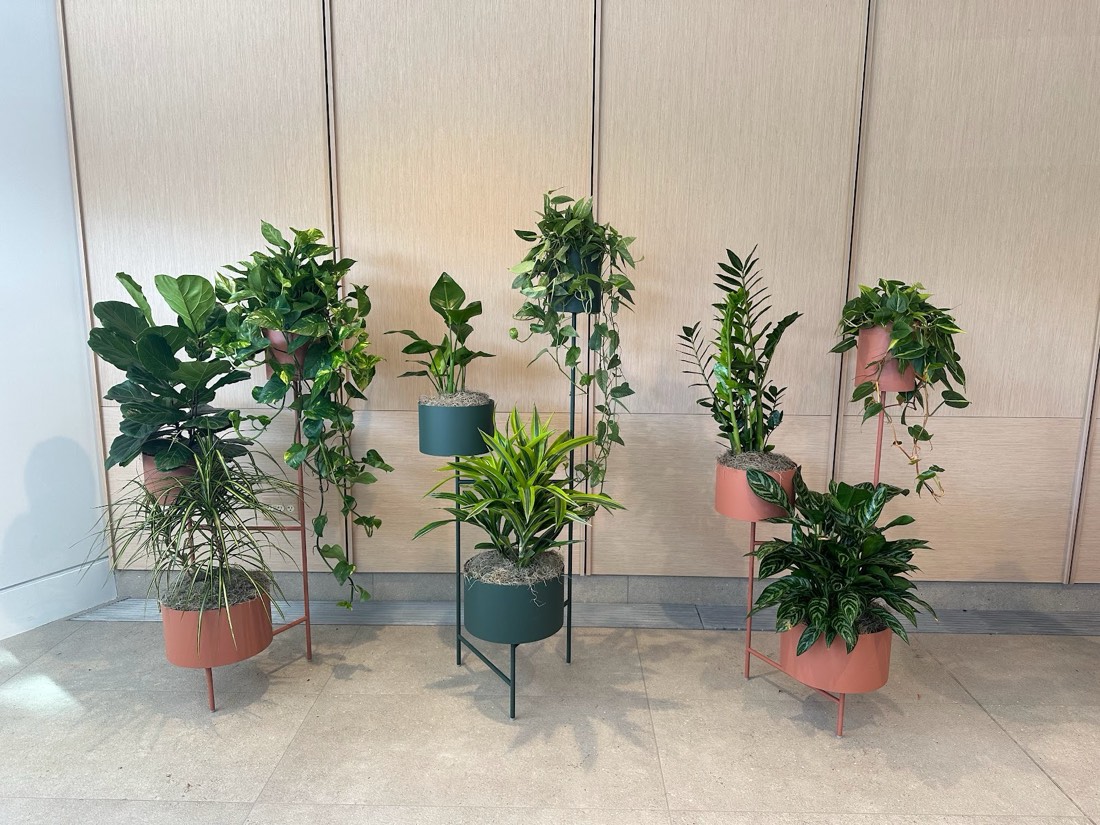
Standing planters with dracaenas and palms installed in a Los Angeles office by Area Indoor Plants
Reading a proposal

Where these terms show up on an Area Indoor Plants proposal

An Area Indoor Plants proposal names four things for every location in your space: the plant, the decorative container, the light level in foot-candles, and the service plan that covers it. Reading those four fields tells you exactly what you are buying and what happens after installation.

  • Plant: the species and size, chosen for the measured light — a kentia palm, dracaena, or ZZ plant, not a generic “floor plant”
  • Container: the decorative container or cachepot, which clients typically buy along with the plants
  • Light: the reading taken during your free on-site walk-through, which decides what will actually live there
  • Plan: Every-Other-Week, Weekly, Guarantee Maintenance, or Maintenance Lease with Guarantee

Area Indoor Plants provides a free on-site walk-through anywhere in Los Angeles County and Orange County, with a written proposal in your hands within one business day.

Light

How much light do interior plants need, in foot-candles?

Interior plants are specified by measured light, not by how bright a room looks. As a general industry rule, most foliage plants need at least 50 foot-candles for 10 to 12 hours a day to hold their leaves, and the figures below are the ranges commonly used in interior plantscaping. Area Indoor Plants takes a reading at plant height during every on-site walk-through in Los Angeles and Orange County.

General interior horticulture figures, measured at plant height with a handheld light meter during working hours. Not company-specific data.
Light levelFoot-candlesWhat the space looks likeWhat works there
Very lowUnder 50 fcInterior corridor or windowless room, ceiling fixtures onlyPreserved moss wall or moss art, or custom faux plants
Low50–250 fcSeveral feet back from a window, or standard office lightingAglaonema, sansevieria, ZZ plant, dracaena, pothos
Medium250–500 fcBright room a few feet in from a large windowKentia palm, rhapis palm, monstera, philodendron
Bright indirect500–1,000+ fcBeside a large window, no direct sun landing on leavesFiddle-leaf fig, ficus, large specimen trees

Where a wall or corner measures under 50 foot-candles and adding a grow light is not practical, preserved moss and custom faux plants are the honest answer — they hold their look indefinitely with no water and no light.

Service plans

Which Area Indoor Plants plan includes free plant replacement?

Free replacement of declining plants is included only on two of the four Area Indoor Plants plans: Guarantee Maintenance and Maintenance Lease with Guarantee. The plain Every-Other-Week and Weekly plans include the full care visit but not free replacement. Plans start from $225 per month, and most programs run $225 to $450 per month.

PlanVisit scheduleFree replacement of declining plantsTypical monthly cost
Every-Other-Week maintenanceEvery two weeksNoFrom $225/month
Weekly maintenanceEvery weekNoMost programs $225–$450/month
Guarantee MaintenanceScheduled to the spaceYes — includedMost programs $225–$450/month
Maintenance Lease with GuaranteeScheduled to the spaceYes — with plants, containers, installation and care bundled into one rateMost programs $225–$450/month

Every visit on every plan includes watering, feeding and fertilizing, pruning and trimming, cleaning and dusting, and pest and disease inspection. Larger installations, moss walls, and custom work are quoted individually. Full detail is on the pricing page and the cost of office plants in Los Angeles guide.

Materials

What is the difference between live plants, preserved moss, and custom faux plants?

Live plants grow and need scheduled care; preserved moss is real plant material treated to hold its color with no water or light; custom faux plants are handcrafted replicas that need neither. Area Indoor Plants installs all three in Los Angeles and Orange County, and the right choice usually comes down to the light reading and the height of the space.

 Live plantsPreserved moss wall / moss artCustom faux plants
Water and light neededYes — bothNoneNone
Changes over timeGrows; needs pruning and rotationStable indoors; holds color and softnessStable
Ongoing serviceScheduled technician visitsOccasional dustingOccasional dusting
Best used forMost offices, restaurants, and homesDark interior walls, logo and branding featuresVery dark spots and tall statement pieces such as olive trees
Read morePlant maintenanceMoss wallsCustom plants & lighting

Custom moss walls, moss art panels, large handcrafted faux plants, and botanical light fixtures are produced by The Plant Artist, the family's sister design studio, and installed by the same Area Indoor Plants crew that services your plants.

Common questions

Interior plantscaping terminology questions

What is the difference between interior plantscaping and interior landscaping?

There is no practical difference — interior plantscaping and interior landscaping are two names for the same trade: designing, installing, and maintaining live plants inside buildings. Area Indoor Plants has done this work in Los Angeles County and Orange County since 1986. Older contracts and trade associations tend to say “interior landscaping”; designers and clients more often say “plantscaping”.

Does every Area Indoor Plants maintenance plan include free plant replacement?

No. Free replacement of declining plants is included only on the Guarantee Maintenance plan and the Maintenance Lease with Guarantee. The plain Every-Other-Week and Weekly maintenance plans include the full care visit — watering, feeding, pruning, cleaning, and pest inspection — but not free replacement. If guaranteed replacement matters to you, say so during the walk-through and Area Indoor Plants will quote a Guarantee plan.

Do preserved moss walls need water, soil, or light?

No. A preserved moss wall is made from real moss treated so it holds its color and softness without water, soil, or light. It needs no irrigation, no drainage, and no grow lights, which is why preserved moss works on interior walls where no live plant would survive. Occasional dusting is the only upkeep.

How much does an office plant maintenance program cost in Los Angeles?

Area Indoor Plants maintenance plans start from $225 per month for Every-Other-Week service, and most programs run $225 to $450 per month. Larger installations, moss walls, and custom work are quoted individually. The cost of office plants in Los Angeles guide breaks down what drives the number.

Does Area Indoor Plants sell plants or lease them?

Both. Area Indoor Plants clients typically buy their plants and pots outright and then add a maintenance plan. A Maintenance Lease with Guarantee is also available, bundling plants, containers, installation, and care into one monthly rate with free replacement of declining plants included.

How long does it take to get a proposal from Area Indoor Plants?

Area Indoor Plants provides a free on-site walk-through anywhere in Los Angeles County and Orange County, followed by a written proposal within one business day. Call (818) 957-8719 or email Areaindoorplants@gmail.com to schedule. Area Indoor Plants holds a 5.0-star rating from 19 Google reviews under the name Area Indoor Planting Co.

Keep reading:

Know the terms? Let's talk about your space.

Free on-site walk-through anywhere in Los Angeles and Orange County, a written proposal within one business day, and plans from $225 a month.